 -
-
Summary of our research
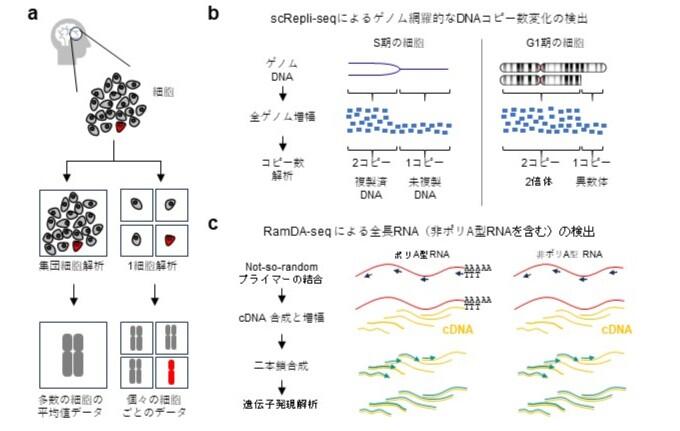
A collaborative research group, including Professor Shin-ichiro Takebayashi(Graduate School of Biological Resources Science, Mie University), Assistant Professor Rawin Poonperm, Graduate students Taiki Yoneda and Taito Imada (at the time of the research), Dr. Ichiro Hiratani (Team Director, RIKEN), and Professor Itoshi Nikaido (Team Director, RIKEN; Institute of Science Tokyo), has developed a novel single-cell analysis technology1 called scRepli-RamDA-seq (scRR-seq). This method allows high-resolution, simultaneous analysis of both genomic DNA2 and RNA within a single cell. By directly linking changes in DNA to changes in gene expression, scRR-seq is expected to help solve problems that have been difficult to address with conventional techniques.
In recent years, advances in single-cell analysis have revolutionized biology by revealing cell-to-cell variability that cannot be captured in analyses of cell populations, leading to discoveries such as the identification of rare abnormal cells.
However, many existing single-cell methods analyze DNA and RNA separately,limiting our understanding of how these molecules are functionally connected. To overcome this limitation, scRR-seq was designed to analyze DNA and RNA simultaneously from a single cell.
This new method was made possible by combining two cutting-edge single-cell analysis techniques previously established by the research team: scRepli-seq, which allows high-resolution analysis of DNA copy number, and RamDA-seq, a highly sensitive RNA sequencing method. The integration of these approaches resulted in scRR-seq, a groundbreaking single-cell analysis technology.
Using scRR-seq, the research team was able to investigate the direct relationship between DNA and gene activity in individual cells. This allowed them to address previously unresolved, long-standing questions in biology and led to the discovery of new markers of cell cycle progression. The study also revealed that the relationship between DNA copy number and gene activity is complex and not always a simple positive correlation.
This research was published in the scientific journal Nature Communications (issue dated December 15, 2025).
This press release is "here."
Researcher information
TAKEBAYASHI Shinichiro
Graduate School of Bioresources Professor
POONPERM RAWIN
Graduate School of Bioresources Assistant Professor
YONEDA Taiki
Graduate School of Bioresources Graduate student (at the time of the research)
IMADA Taito
Graduate School of Bioresources Graduate student